
Cornhole Tips & Strategies
OFFENSIVE VS. DEFENSIVE
CORNHOLE STRATEGIES
Learn when to block, when to score, and how to make smarter decisions during a cornhole match. Discover offensive and defensive techniques that can help you control the board and improve your game.
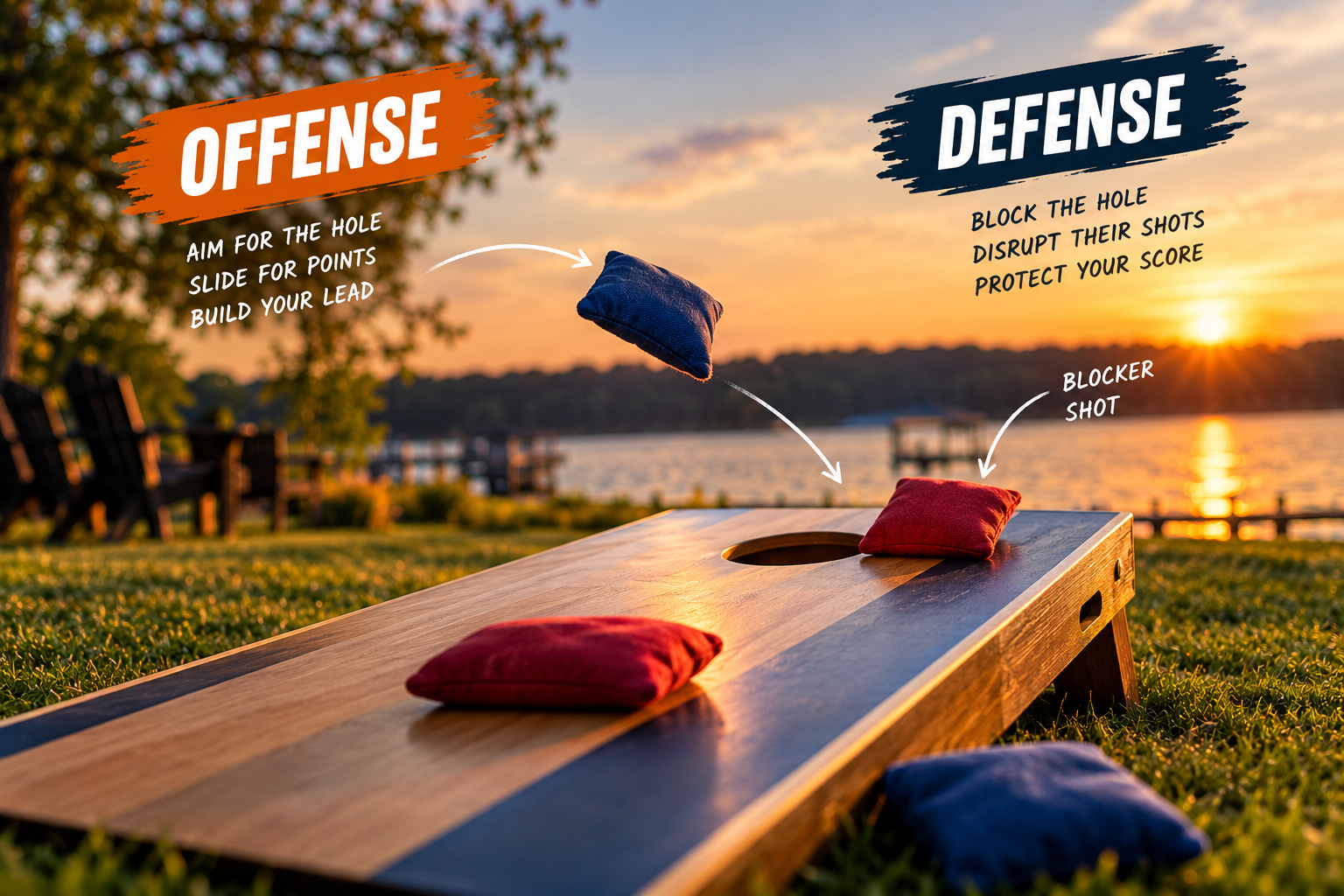
Cornhole might look like a straightforward game of tossing bags toward a wooden board, but experienced players understand that every throw presents a strategic decision. While landing bags in the hole is the ultimate goal, there are situations where blocking an opponent, protecting your position, or changing your throwing approach can be just as important as scoring points.
Understanding the differences between offensive and defensive cornhole strategies can help players make better decisions throughout a match. Rather than throwing every bag toward the hole without considering the current situation, strategic players evaluate the board, their opponent’s position, and the score before choosing their next shot.
Whether you’re playing casually with friends or participating in a competitive tournament, knowing when to attack and when to defend can make your game more consistent and difficult to counter.
WHAT IS THE DIFFERENCE BETWEEN OFFENSIVE AND DEFENSIVE CORNHOLE?
Offensive cornhole strategies focus on scoring points by landing bags on the board or sending them through the hole. Defensive strategies focus on making it more difficult for opponents to score, often by placing bags in positions that obstruct their preferred throwing paths.
Offensive Cornhole
Prioritizes scoring opportunities, open throwing lanes, slide shots, and accurate throws toward the hole.
Defensive Cornhole
Prioritizes blocking the hole, disrupting an opponent’s preferred shots, and protecting an existing scoring advantage.
Both approaches are important because cornhole uses cancellation scoring. At the end of each round, only the difference between the two players’ or teams’ scores is added to the overall game total.
For example, if you score nine points during a round and your opponent scores six, you receive three points toward your total score. Even if you make several successful throws, your opponent can cancel out those points by matching your performance.
This means the best cornhole strategy isn’t always the one that produces the most individual points. Sometimes, preventing an opponent from scoring can be just as valuable.
OFFENSIVE CORNHOLE STRATEGIES: WHEN TO FOCUS ON SCORING
Offensive cornhole is centered around creating scoring opportunities and maximizing the value of each bag. Players using an offensive approach generally prioritize open throwing lanes, accurate placement, and shots that can reach the hole.
Although aggressive play can create opportunities to build a lead, it also requires careful consideration of the board’s current layout.
Aim for the Hole When the Board Is Open
An unobstructed board often presents the best opportunity to play offensively. When there are no bags blocking the hole, you can focus on placing your throw in a position that allows it to enter the opening directly or slide toward it.
A bag through the hole is worth three points, while a bag remaining on the board is worth one point. Because of this difference, making a successful hole shot can significantly improve your position during a round.
However, throwing directly at the hole isn’t always necessary. Depending on your preferred throwing technique, landing a bag slightly below the hole and allowing it to slide forward may produce a more consistent result.
Use Slide Shots to Create Scoring Opportunities
A slide shot involves landing a cornhole bag on the board and allowing it to travel toward the hole.
This technique is particularly useful when the surface is open and there is enough space for the bag to move forward after landing.
The effectiveness of a slide shot depends on several factors, including the bag’s fabric, the condition of the board, and the angle at which the bag lands.
Players who prefer slide shots often aim for the lower or middle portion of the board rather than attempting to drop every bag directly into the hole.
Developing control over your bag’s landing position can make this offensive approach more predictable.
Take Advantage of Your Opponent’s Misses
When an opponent misses the board entirely, you have an opportunity to build a scoring advantage without immediately needing to overcome their existing points.
For example, if your opponent throws a bag off the board, a successful one-point landing gives you an advantage for that exchange. A three-point hole shot creates an even larger difference.
Rather than becoming overly aggressive after an opponent misses, continue using the throwing technique that produces your most reliable results.
Consistency is often more valuable than attempting a difficult shot simply because an opportunity has appeared.
Offensive strategy tip: When the board is open, focus on your most repeatable scoring shot. A controlled slide toward the hole may be more reliable than forcing a difficult direct shot.
DEFENSIVE CORNHOLE STRATEGIES: HOW TO BLOCK YOUR OPPONENT
Defensive cornhole strategies focus on controlling access to the hole and forcing opponents to attempt more difficult shots.
Instead of treating every bag as an immediate scoring opportunity, defensive players consider where their bags will remain on the board and how those positions might affect future throws.
Use a Blocker Bag to Protect the Hole
One of the most recognizable defensive techniques is the blocker shot.
A blocker involves placing a bag below the hole, generally along an opponent’s preferred path toward the opening.
When positioned effectively, the bag can prevent a direct slide shot and force the opposing player to change their approach.
For example, an opponent who normally throws low, controlled slide shots may have difficulty reaching the hole when a bag is positioned directly in front of it.
The opponent might need to throw a higher shot, attempt to move the blocker, or aim for another portion of the board.
A well-placed blocker can also remain worth one point if it stays on the playing surface.
Force Your Opponent to Change Their Throw
Many cornhole players develop a preferred throwing motion and trajectory through repeated practice.
Defensive play can become particularly effective when it forces an opponent to move away from that comfortable technique.
A player who consistently relies on slide shots may struggle when required to throw a higher airmail shot. Similarly, someone who prefers a direct path toward the hole may need to adjust their aim when several bags occupy the center of the board.
The objective isn’t necessarily to prevent every scoring opportunity. Instead, defensive placement can increase the difficulty of the opponent’s next throw.
Protect a Lead With Controlled Placement
When you’re ahead in a game, defensive decisions can help reduce opportunities for your opponent to recover.
For instance, if your opponent needs several points to close the gap, placing a blocker may make it harder for them to produce a high-scoring round.
However, playing defensively doesn’t mean abandoning scoring altogether. A bag that remains on the board can contribute to your round total while also creating an obstacle.
The most effective defensive approach often combines point accumulation with thoughtful bag placement.
WHEN SHOULD YOU BLOCK INSTEAD OF GOING FOR THE HOLE?
Choosing between a blocker and an offensive shot depends on the board’s layout, the score, and your confidence in different throwing techniques.
There isn’t one correct decision for every situation. However, several common scenarios can help guide your approach.
When Your Opponent Is Consistently Scoring
If your opponent repeatedly sends bags through the hole, continuing to exchange open scoring opportunities may not be enough to gain an advantage.
Placing a blocker can disrupt their preferred throwing lane and require them to attempt a different shot.
This approach can be particularly useful against players who depend heavily on sliding bags into the hole.
When You Already Have a Scoring Advantage
Suppose you’ve placed a bag through the hole and your opponent hasn’t scored yet.
You may decide to place your next bag below the hole rather than immediately attempting another three-point shot.
This creates an obstacle that could make it harder for your opponent to cancel your existing points.
However, the decision depends on your ability to place the blocker accurately and whether it might interfere with your own future throws.
When the Hole Is Partially Blocked
A crowded board changes the available scoring opportunities.
If another bag is positioned directly in front of the hole, a standard slide shot may no longer be practical.
You might attempt an airmail shot, use a push shot to move the blocking bag, or place your own bag in a position that limits your opponent’s options.
Recognizing when the board requires a different approach is an important part of developing more advanced cornhole strategies.
WHEN SHOULD YOU PLAY AGGRESSIVELY?
Defensive placement can be useful, but there are also situations where focusing on scoring is the better decision.
When You’re Behind Late in the Game
If your opponent is approaching 21 points and you’re several points behind, relying entirely on one-point board placements may not provide enough scoring opportunities to recover.
An aggressive approach focused on hole shots can help you create larger point differences during a round.
However, remember that cancellation scoring still applies. Your opponent’s successful throws can offset your points, so shot selection should account for the entire round rather than individual throws alone.
When You Have an Open Path to the Hole
If the board is clear and you’re comfortable with your throwing technique, there may be little reason to introduce unnecessary defensive obstacles.
An open lane can provide an opportunity for a controlled slide shot or direct hole shot.
Players should consider their own strengths when deciding whether to take advantage of this opening.
When Your Opponent Struggles With Scoring
If your opponent is consistently missing the board or struggling to land bags near the hole, an offensive strategy may help you build a lead more efficiently.
Instead of focusing on blocking an opponent who is already having difficulty scoring, prioritize making accurate throws and collecting points.
As the match develops, you can adjust your strategy if their performance improves.
ADVANCED CORNHOLE SHOTS FOR OFFENSIVE AND DEFENSIVE PLAY
As players become more comfortable with basic throwing mechanics, they can begin incorporating different shot types into their strategy.
Each shot has a particular purpose, and knowing when to use it can help you respond to changing board conditions.
The Airmail Shot
An airmail shot sends the bag through the air directly toward the hole, generally with a higher trajectory that avoids sliding across the board.
This shot can be useful when an opponent’s blocker prevents a normal slide shot.
However, airmail attempts require accurate distance and trajectory control. Missing the hole may cause the bag to land beyond the board, depending on the throw.
The Push Shot
A push shot involves throwing a bag into another bag already resting on the board, attempting to move it toward or into the hole.
Players may use this technique to move their own bag into a scoring position or displace an opponent’s blocker.
The result depends on the location of the bags, the impact angle, and the force of the throw.
The Blocker Shot
A blocker shot is designed primarily around placement rather than immediately reaching the hole.
Players attempt to position a bag where it interferes with an opponent’s preferred throwing path.
Successful blocking requires an understanding of the opponent’s throwing style and the amount of space available on the board.
The Roll Shot
A roll shot is an advanced technique intended to make a bag roll or flip over an obstacle rather than slide normally along the board.
Experienced players may use this shot to navigate around blocking bags.
Because the movement can be difficult to control, beginners are generally better served by developing consistent basic throws before attempting it regularly.
HOW CANCELLATION SCORING AFFECTS CORNHOLE STRATEGY
Understanding cancellation scoring is essential when deciding whether to play offensively or defensively.
Unlike games where every successful shot contributes directly to the final score, cornhole awards the difference between the two sides’ round totals.
Consider the following example:
| Round Result | Your Team | Opponent |
|---|---|---|
| Bags through the hole | 2 | 1 |
| Bags remaining on board | 2 | 3 |
| Total round points | 8 | 6 |
| Points added to game score | 2 | 0 |
Even though both teams scored multiple points, only two points are added to your team’s overall score.
This scoring system makes strategic decisions especially important. A successful blocker can help protect a scoring advantage, while an accurate hole shot can overcome an opponent’s existing points.
For a complete explanation of gameplay and scoring, visit our guide on how to play cornhole .
COMMON CORNHOLE STRATEGY MISTAKES TO AVOID
Players sometimes focus so heavily on individual throws that they overlook the larger situation developing throughout a match.
Avoiding a few common strategic mistakes can help improve your decision-making.
- Always aiming directly for the hole: Although hole shots are valuable, there are situations where placing a blocker or securing a point on the board may be more useful.
- Blocking too early: Placing a defensive bag before considering your own scoring opportunities can make the board more difficult for you as well.
- Ignoring your opponent’s throwing style: Defensive placement is most effective when it accounts for how the opposing player typically approaches the board.
- Attempting advanced shots without practice: Airmails, push shots, and roll shots can be useful, but attempting them without sufficient control may lead to unnecessary misses.
- Focusing only on the overall score: The number of points already on the board during the current round also matters because those points determine what can be canceled.
- Refusing to adjust your approach: A strategy that works early in a match may become less effective as the board conditions and opponent’s decisions change.
HOW TO PRACTICE OFFENSIVE AND DEFENSIVE CORNHOLE STRATEGIES
Developing strategic awareness requires more than improving your throwing accuracy. Players also need to practice recognizing different situations and selecting appropriate shots.
One useful exercise involves placing a bag directly below the hole and attempting to score around it. Try using a higher trajectory, moving the blocker, or landing your bag in an open area.
Another drill involves starting each round with an imaginary scoring advantage. For example, assume you’ve already scored three points and must decide whether to attempt another hole shot or protect your position with a blocker.
You can also practice switching between offensive and defensive approaches during the same round. Begin with a normal scoring attempt, follow it with a blocker, and then try to navigate around the obstacle you’ve created.
These exercises encourage you to think about bag placement rather than focusing exclusively on whether each throw reaches the hole.
If you’re still developing your throwing fundamentals, review our guide on how to throw cornhole bags before incorporating more advanced techniques.
Practice tip: Try playing a few rounds where your goal is to place at least one blocker, followed by rounds where you focus on open scoring opportunities. Comparing the results can help you recognize which strategy works best in different situations.
FINDING THE RIGHT BALANCE BETWEEN OFFENSE AND DEFENSE
The best cornhole players don’t rely exclusively on one approach. Instead, they adjust their strategy based on the board, the score, and their opponent’s strengths.
Offensive play is often most useful when you have a clear scoring opportunity, need to recover from a deficit, or want to capitalize on an opponent’s missed throws.
Defensive play can become valuable when you’re protecting a scoring advantage, facing a consistently accurate opponent, or attempting to disrupt a preferred throwing lane.
Ultimately, successful cornhole strategy involves knowing what you’re trying to accomplish with each bag. Sometimes that means aiming directly for the hole. Other times, it means placing a bag where it will make your opponent’s next throw more difficult.
As you practice, experiment with both approaches and pay attention to how different decisions affect the outcome of each round. You can use our Cornhole Scorekeeper to track scores during practice matches and see how your strategies perform over time.